As an FY2, you are likely paying for GMC, BMA and medical indemnity.
A typical FY2 pays £798 a year on these. £151 of it can come back from HMRC, if you keep the receipts.
Estimates from published fees for a typical full-time FY2. Yours might differ. Fees checked on against each body’s own fee page.
FY2 take-home pay after tax and NHS Pension ›FY2 tax rebate on fees, back four years ›
What you pay, receipt by receipt
A typical FY2 has three costs, all paid every year. The GMC charges £481 to keep you registered, at the lower rate for doctors within five years of qualifying. The BMA charges £292 for membership. Medical indemnity is quoted to you individually.
Together that is £798 a year, with no royal college exam to pay for. You can get tax back on all three, if you claim it.

GMCreceipt.pdf
GMC annual fee
With a licence to practise
Total£481.00
✓ HMRC tax back
BMAcard statement
BMA membership
Annual subscription
Tax back on 85% of the fee
£24.33 a month
Total£292.00
✓ HMRC tax back

FY2a typical year
You pay in total£798
HMRC, 20%£151
Logos belong to their owners and show where each fee goes. Reimbsr is not affiliated with these bodies.
Who pays you back
In a typical FY2 year only HMRC pays you back, and only when you ask. There is no exam for your trust to pay back.
Nothing in a typical FY2 year
Your trust pays back royal college exams, and a typical FY2 year has none. So nothing above comes back from your trust.
From April 2027 your trust will also pay back royal college membership and portfolio fees. Until then, you get tax back on those instead.
GMC, BMA and medical indemnity
HMRC gives back tax on fees you pay yourself, at your income tax rate. The estimate uses 20% for an FY2, and HMRC counts 85% of the BMA fee.
Claim on the P87, HMRC's form for claiming tax back on work costs you pay yourself (like GMC and BMA fees). It covers this tax year and the last four, so fees from your FY1 year still count. Over £2,500 in a year, use a Self Assessment tax return instead.
Claiming is easy. Proving it, a year later, is not.
A few fees a year feels easy to remember. But each goes to a different body on a different date, and the receipts land in different places. A P87 reaches back over this tax year and the last four, so your FY1 receipts count too.
- GMC, BMA and medical indemnity fees leave your account on different dates, with no single record.
- The GMC fee is paid once a year, so by the time you claim, the receipt is buried in an old email.
- Your medical indemnity invoice, from the MDU, MPS or MDDUS, sits in a portal you rarely open.
- The P87 needs a year of statements, gathered in one go.
Keep each receipt the day it arrives, and the claim is ready when you are.
Reimbsr keeps the proof from the day you pay
Nothing to remember: snap or forward each receipt when it arrives. Reimbsr reads the amount and date, works out who pays you back, and keeps it all ready for your P87.
- Snap it or forward itSnap the receipt, forward the email to your own Reimbsr address, or add a drive. It reads the amount, date and claim deadline for you.
- See who pays you backEach expense is sorted into what your trust pays back and what HMRC gives tax back on, with the rule behind it. Not sure? Ask Reimbsr. It answers from published NHS and HMRC guidance, with sources, and in a grey area writes the question for you to send to medical staffing.
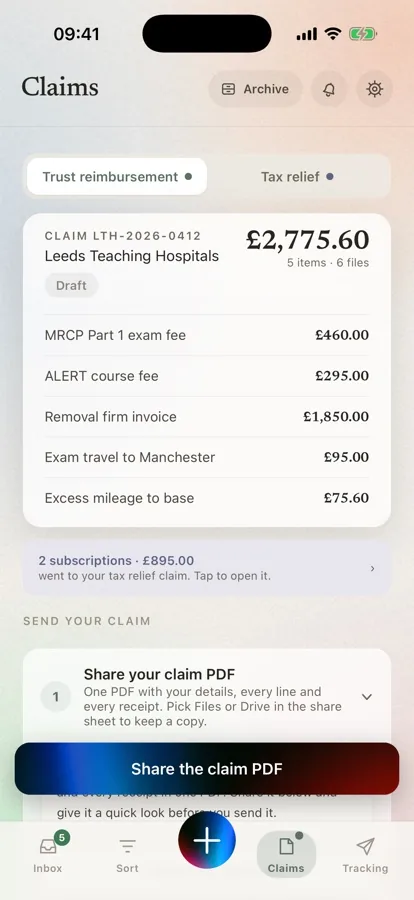
- Check it, then send itReimbsr builds one PDF with every line and receipt, and drafts the email to whoever approves your expenses. You check it and send it from your own email.
- Get your tax backIt fills in your P87 at the end of the tax year, on Free and Pro, so you get tax back on the fees your trust does not pay.
Doctors like you (FY2) are typically eligible for £151 back as tax relief a year.It will be free to try; you may never need to upgrade. Pro is £49.99 a year (£0.96 a week), only if it saves you more than it costs. See pricing ›
Free to start. Upgrade only if it pays.
In keeping with making financially savvy decisions, Reimbsr will be free to try. Only upgrade to the Pro version (£0.96 a week) if you think the app can help you save more money than it costs.